
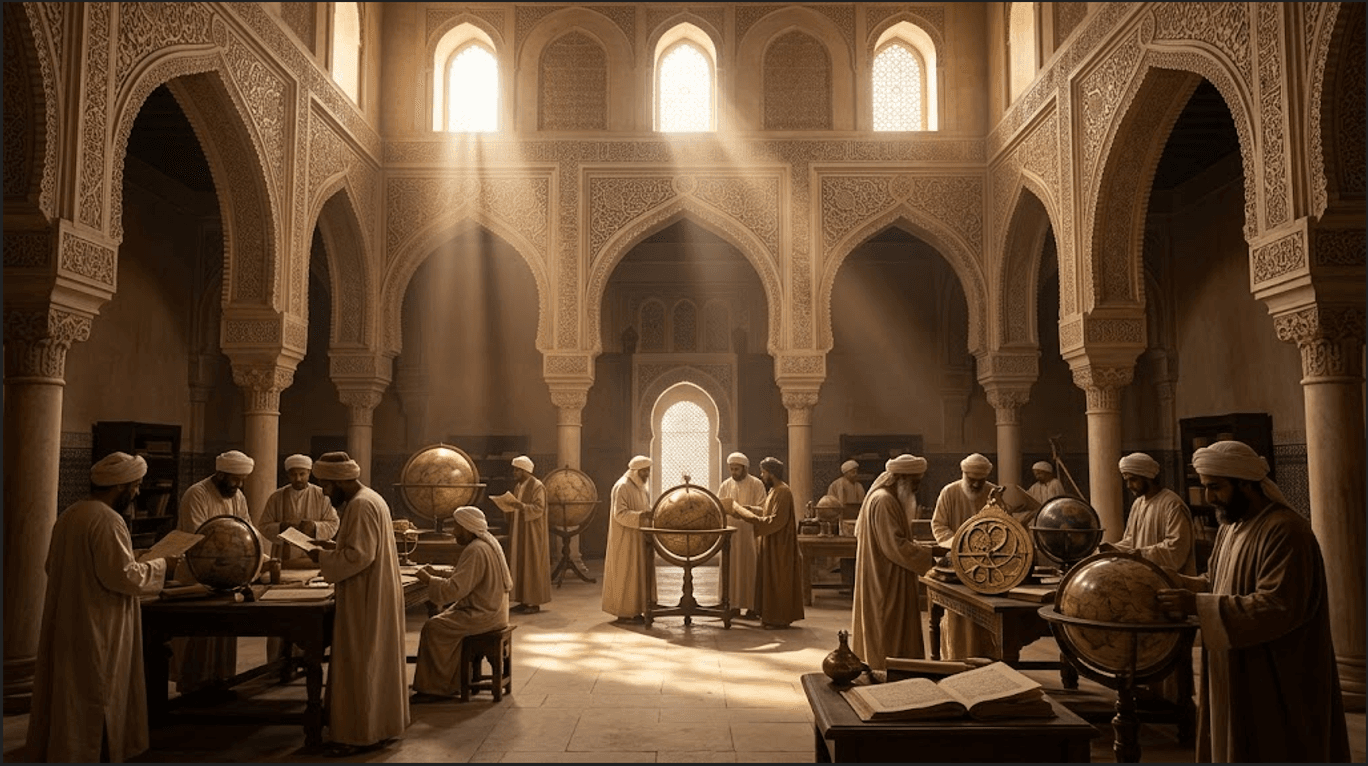
Throughout Islamic history, the acquisition and preservation of beneficial knowledge (‘Ilm) has never been regarded as a mere intellectual luxury. It is a sacred trust (Amanah) woven into the foundational ethos of the Quran and the Sunnah, establishing a civilizational imperative that catalyzed the greatest scientific, philosophical, and ethical flourishing of the medieval world: the Islamic Golden Age.
1. The Quranic Mandate for Knowledge and Contemplation
The very first word revealed to the Prophet Muhammad (ﷺ) on the Mount of Light was “Iqra” (Read/Proclaim). From its inception, Islam consecrated the pursuit of truth as an act of worship. The Quran repeatedly challenges believers to observe, reflect, and investigate:
“Say, ‘Are those who know equal to those who do not know?’ Only they will remember who are people of understanding.”
— Surah Az-Zumar (39:9)
In classical Islamic epistemology, scholars like Imam al-Ghazali and Ibn Rushd (Averroes) emphasized that all genuine truth ultimately emanates from the Divine. Investigating the natural laws of astronomy, medicine, mathematics, and philosophy was seen not as a departure from faith, but as a deeper contemplation of Allah’s signs (Ayat) written into the fabric of creation.
2. Bayt al-Hikma: The Epicenter of the Global Knowledge Commons
Under the Abbasid Caliphate in 8th and 9th-century Baghdad, this religious devotion to knowledge crystallized in the founding of Bayt al-Hikma (The House of Wisdom). Visionary leaders like Caliph Harun al-Rashid and al-Ma’mun mobilized immense civilizational resources toward the massive Translation Movement.
Scholars traveled across continents to collect Sanskrit, Persian, Syriac, and classical Greek manuscripts. In Baghdad, these works were not merely translated; they were rigorously audited, corrected, and expanded:
- Al-Khwarizmi synthesized Hindu and Babylonian numerical concepts to develop Algebra (Al-Jabr) and algorithmic computation.
- Ibn al-Haytham (Alhazen) revolutionized optics and pioneered the modern empirical scientific method centuries before the European Renaissance.
- Al-Biruni calculated the radius of the Earth with remarkable precision while authoring unmatched sociological treatises on comparative religions.
3. Knowledge as an Open Trust: Beyond Monopolies of Power
Crucially, classical Islamic civilization viewed knowledge as a universal collective heritage rather than a proprietary corporate asset to be hoarded. Libraries, madrasas, and translation centers were funded permanently through Waqf (charitable endowments), ensuring that scholars, students, and travelers could access manuscripts free of cost.
This commitment to open inquiry established what modern philosophers and sociologists describe as an enduring epistemic commons and the preservation of independent inquiry—a protected intellectual ecosystem where truth is preserved against institutional decay, political censorship, and commercial distortion.
4. The Danger of Intellectual Stagnation in the Modern Era
Today, the Muslim world faces a dual challenge: the secular commodification of education on one side, and anti-intellectual superficiality on the other. Reviving the spirit of Bayt al-Hikma requires recovering the core Islamic understanding that rigorous scientific research, ethical philosophy, and technical mastery are communal obligations (Fard Kifayah).
When Muslims dedicate themselves to deep learning, peer-reviewed excellence, and ethical stewardship of technology, they honor the profound prophetic invocation:
“O Allah, I ask You for knowledge that is beneficial, a good provision, and deeds that are accepted.”
— Sunan Ibn Majah
Conclusion
The Islamic Golden Age was not an accident of geography; it was the direct harvest of an unwavering worldview that revered truth wherever it was found. As Muslims navigate an era of rapid technological disruption, preserving this sacred ethos of learning and intellectual integrity remains the single most vital duty for future generations.